Dokan implementation
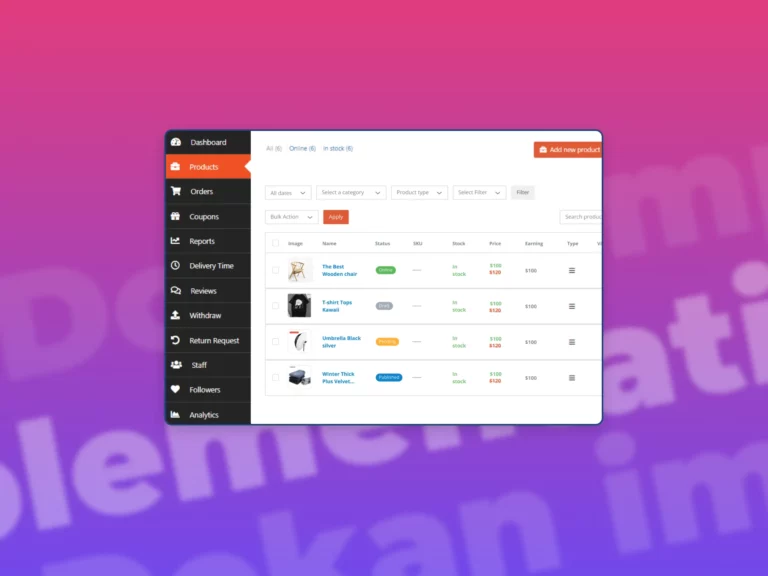
Dokan Multi-Vendor Marketplace Implementation
Dokan implementation transforms a WordPress and WooCommerce website into a fully operational multi-vendor marketplace.
Rather than operating as a single-seller e-commerce store, a marketplace allows independent vendors to register, manage their own storefronts, list products, process orders, and receive payouts while the platform owner controls commission structures, vendor permissions, and overall governance.
This model enables businesses to build platform-based revenue ecosystems instead of traditional inventory-based stores.
What Dokan Enables?
Dokan extends WooCommerce with marketplace functionality, including:
- Vendor registration and approval workflows
- Individual vendor dashboards
- Commission configuration and tracking
- Order management per vendor
- Payout management systems
- Storefront customization per seller
- Vendor-specific reporting and analytics
The platform owner retains administrative oversight while vendors manage daily operations independently.
Marketplace Business Model Advantages
Commission-Based Revenue Infrastructure
Marketplace owners earn a percentage or fixed fee from each transaction. Revenue scales with vendor activity rather than inventory ownership.
This creates recurring income without product sourcing risk.
Inventory-Free Expansion
Product catalog growth is driven by vendor onboarding. The platform can scale to thousands of SKUs without warehousing, procurement, or stock management responsibilities.
Vendors maintain inventory control, shipping logistics, and customer handling for their products.
Vendor-Led Traffic Growth
Vendors often bring existing audiences to the platform. As sellers promote their storefronts, overall marketplace visibility increases.
This creates shared acquisition momentum.
Network Effects and Platform Growth
As vendor participation increases, product diversity expands. Increased product diversity attracts more buyers. Increased buyer demand attracts more vendors.
Well-structured marketplaces benefit from compounding growth dynamics over time.
Operational Structure and Governance
Dokan implementation is not only technical configuration. It requires operational planning.
Key considerations include:
- Vendor onboarding criteria
- Commission tiers by category
- Quality control and moderation workflows
- Payout timing and financial reconciliation
- Dispute resolution policies
- Brand consistency guidelines
A successful marketplace balances automation with governance.
When Multi-Vendor Marketplace Implementation Makes Strategic Sense
Dokan implementation is particularly relevant when:
- You want to build a platform business model
- Your niche supports multiple independent sellers
- You want to monetize community participation
- You aim to reduce inventory risk
- You seek recurring commission revenue
- You want to expand product variety rapidly
This model is common in:
- Local artisan marketplaces
- Niche product ecosystems
- Digital product platforms
- Service provider directories
- Hospitality and experience aggregation platforms
Our WordPress and WooCommerce Marketplace Approach
Effective Dokan implementation requires:
- WooCommerce architecture alignment
- Secure payment gateway configuration
- Commission rule engineering
- Vendor role configuration
- Performance optimization
- Hosting scalability planning
- SEO structuring for vendor pages
- Tax and compliance alignment
We configure Dokan within a scalable WordPress environment to ensure performance stability under multi-vendor activity.
Marketplace SEO and Discoverability
Each vendor storefront and product listing can be optimized for search visibility. Structured URLs, category hierarchies, and metadata planning are essential to ensure the marketplace grows organically.
Without structured SEO planning, vendor-generated content may fail to index effectively.
Strategic Outcome
With properly implemented Dokan marketplace architecture, your platform gains:
- Commission-based recurring revenue
- Scalable product expansion
- Reduced operational inventory risk
- Independent vendor management
- Compounding network effects
- Platform-level growth potential
Instead of managing products alone, you manage a digital ecosystem.
Build Your Marketplace Infrastructure
If your business model supports multiple vendors and commission-based revenue, Dokan implementation provides the technical and operational framework to launch a scalable marketplace.
Contact our team to design and implement a WordPress multi-vendor marketplace aligned with your strategic vision.

Schedule a discovery call and tell us about your project