Advanced Custom Fields (ACF)
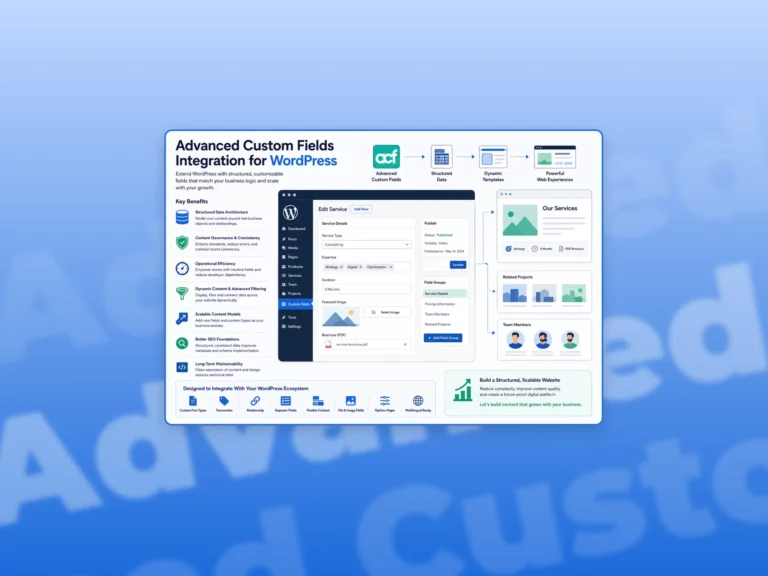
Advanced Custom Fields Integration for WordPress
Advanced Custom Fields integration extends WordPress beyond its default editor by enabling structured, customizable data fields aligned with your business requirements.
Instead of relying solely on titles and open text areas, ACF enables defined content structures such as product specifications, service attributes, team profiles, event metadata, portfolio details, relationship fields, repeatable sections, image galleries, and file uploads.
This transforms WordPress from a basic publishing tool into a structured content management system designed around operational logic and long-term scalability.
What Advanced Custom Fields Solves
Standard WordPress installations rely heavily on unstructured content. This often leads to inconsistent layouts, missing information, formatting errors, and increasing dependency on developers for simple updates.
ACF addresses these limitations by introducing structured data modeling, guided editorial workflows, and dynamic template integration. The result is cleaner architecture, stronger governance, and more scalable content management.
Key Business Benefits of Advanced Custom Fields Integration
Structured Data Architecture Aligned With Business Logic
ACF allows your website to reflect real operational structures instead of generic content blocks. Product specifications, certifications, technical attributes, pricing variables, service parameters, and team credentials can all be modeled as structured data fields.
This ensures your digital platform mirrors how your business actually functions, improving clarity, maintainability, and long-term scalability.
Content Governance and Editorial Control
Predefined field groups enforce consistency across content types. Mandatory fields prevent incomplete entries, while structured inputs reduce formatting inconsistencies.
This protects brand presentation, ensures uniform information across pages, and creates predictable publishing standards for organizations with multiple contributors.
Operational Efficiency for Internal Teams
Non-technical users interact with intuitive, guided input interfaces instead of unstructured editors. Content updates follow defined workflows, reducing dependency on developers for routine changes.
This accelerates publishing cycles while maintaining structural integrity.
Dynamic Content Delivery and Advanced Filtering
ACF enables structured data to be dynamically displayed across templates. Content can be filtered, queried, and connected through relationships between different post types.
Examples include filtering services by expertise, connecting projects to team members, displaying related products based on attributes, or building advanced search functionality.
This enhances user experience and supports more sophisticated customer journeys.
Scalable Content Models Without Rebuilding
As your business evolves, new field groups and data models can be introduced without redesigning the entire website.
ACF supports incremental expansion of your content architecture, enabling growth in product lines, services, multilingual structures, and digital assets while preserving system stability.
Improved SEO Through Structured Consistency
Structured data improves internal consistency, making it easier to implement schema markup, generate uniform metadata, and maintain index clarity.
While ACF does not replace SEO strategy, it provides the structural foundation that makes technical optimization significantly more effective.
Long-Term Maintainability and Reduced Technical Debt
By separating structured data from presentation layers, ACF creates cleaner and more maintainable architecture. Content remains independent from layout decisions, reducing technical debt during redesigns, theme updates, or migrations.
This strengthens long-term system resilience.
Our Implementation Approach
Effective ACF integration requires strategic planning rather than random field creation.
We begin by analyzing your operational model and defining content types that reflect business logic. Field groups are architected to support scalability, multilingual expansion if required, and compatibility with your theme and plugins.
Templates are configured to dynamically render structured data while preserving performance and design integrity. The result is a stable, scalable content infrastructure aligned with growth objectives.
Strategic Outcome
With Advanced Custom Fields properly implemented, your WordPress platform becomes a structured digital asset rather than a simple content editor. You gain:
- Greater editorial control
- Improved content consistency
- Reduced developer dependency
- Enhanced scalability
- Stronger SEO foundations
- Long-term maintainability
ACF integration positions your website for growth, complexity, and operational clarity.
Structure Your Content for Long-Term Growth
Transform WordPress into a structured content system aligned with your business logic. Contact our team to implement Advanced Custom Fields with a scalable, governance-driven architecture.
Projects
Schedule a discovery call and tell us about your project